

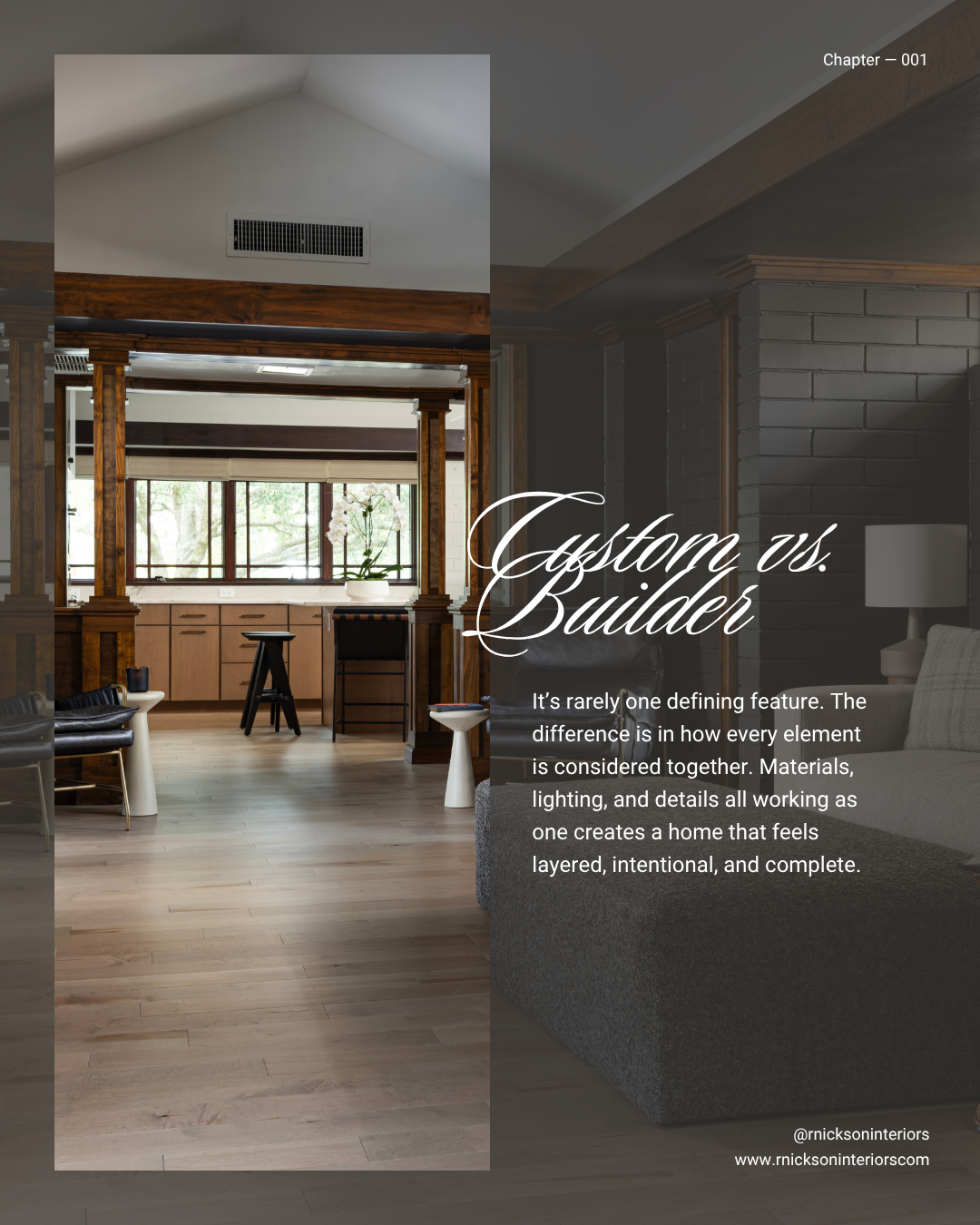


There’s a common assumption that a custom home simply comes down to budget.
More money, better result.
But that’s not actually what creates the difference.
We’ve seen homes with generous budgets still feel disconnected, and others with thoughtful planning feel incredibly refined. The distinction isn’t just what you spend. It’s how decisions are made.
It Starts With Intention
A custom home isn’t defined by one standout feature. It’s the result of hundreds of small, intentional decisions that build on each other.
Materials are selected in relationship, not in isolation.
Lighting is considered early, not added at the end.
Details are integrated, not layered on as an afterthought.
Nothing feels random. Everything feels connected.
That level of intention is what creates a sense of cohesion the moment you walk in.
Materials That Speak the Same Language
One of the most noticeable differences in a custom home is how materials work together.
In builder-grade spaces, selections are often made for efficiency. Each finish may look fine on its own, but there’s no larger conversation happening between them.
In a custom home, materials are chosen with context in mind. Tone, texture, and scale are all considered so that each element complements the next.
The result is a space that feels layered and balanced rather than pieced together.
Lighting That Shapes the Experience
Lighting is one of the most underestimated elements in a home, yet it has one of the biggest impacts on how a space feels.
Builder-grade homes often treat lighting as a final step. Fixtures are selected quickly, and placement follows a standard plan.
In a custom home, lighting is part of the design from the beginning.
It’s scaled to the space.
It’s layered for function and atmosphere.
It highlights architecture and materials rather than competing with them.
This is what creates depth and warmth instead of flat, uniform light.
Details That Feel Considered
Details are where a home either comes together or falls apart.
Hardware, trim, transitions, proportions. These are the elements that quietly define the overall experience.
In builder-grade homes, these decisions are often made individually. In a custom home, they’re part of a larger system.
Every detail feels like it belongs because it was chosen with the whole in mind.
The Feeling You Can’t Quite Name
When a home is thoughtfully designed, you feel it immediately.
It’s not about one focal point. It’s the overall sense that everything is working together.
The space feels calm, cohesive, and complete.
That’s what people are responding to when they say a home feels “custom.”
Where It All Begins
If you’re planning to build or renovate, this is the shift that matters most.
Before finishes are selected.
Before construction begins.
Before decisions start stacking on top of each other.
The foundation of a custom home is thoughtful planning.
Because in the end, it’s not about creating something more complicated. It’s about creating something more considered.